
Leviticus 14:21-32 is about the purification rituals involving the blood of a guilt offering, symbolic of atonement for sins and the restoration of one’s relationship with God.
21 But if he is poor and cannot afford so much, then he shall take one male lamb for a guilt offering to be waved, to make atonement for him, and a tenth of an ephah of fine flour mixed with oil for a grain offering, and a log of oil;
22 And two turtledoves or two pigeons, whichever he can afford, one shall be a sin offering and the other a burnt offering.
23 And on the eighth day he shall bring them for his cleansing to the priest, to the entrance of the tent of meeting, before the Lord.
24 And the priest shall take the lamb of the guilt offering and the log of oil, and the priest shall wave them for a wave offering before the Lord.
25 And he shall kill the lamb of the guilt offering. And the priest shall take some of the blood of the guilt offering and put it on the lobe of the right ear of him who is to be cleansed, and on the thumb of his right hand and on the big toe of his right foot.
26 And the priest shall take one male lamb and offer it for a guilt offering, along with the log of oil, and wave them for a wave offering before the Lord.
27 And if he is poor and cannot afford so much, then he shall take one male lamb for a guilt offering to be waved, to make atonement for him, and a tenth of an ephah of fine flour mixed with oil for a grain offering, and a log of oil;
28 And the priest shall put some of the oil that is in his hand on the lobe of the right ear of him who is to be cleansed and on the thumb of his right hand and on the big toe of his right foot, in the place where the blood of the guilt offering was put.
29 And the rest of the oil that is in the priest’s hand he shall put on the head of the one to be cleansed. Then the priest shall make atonement for him before the Lord.
30 And he shall offer, of the turtle-doves or pigeons, such as he can afford,
31 And if the priest makes the anointed one, who is to be cleansed, stand before the Lord, and the priest shall take from the log of oil and shall pour it into the palm of his own left hand
32 This is the law for him in whom is a case of leprous disease, who cannot afford the offerings for his cleansing.”
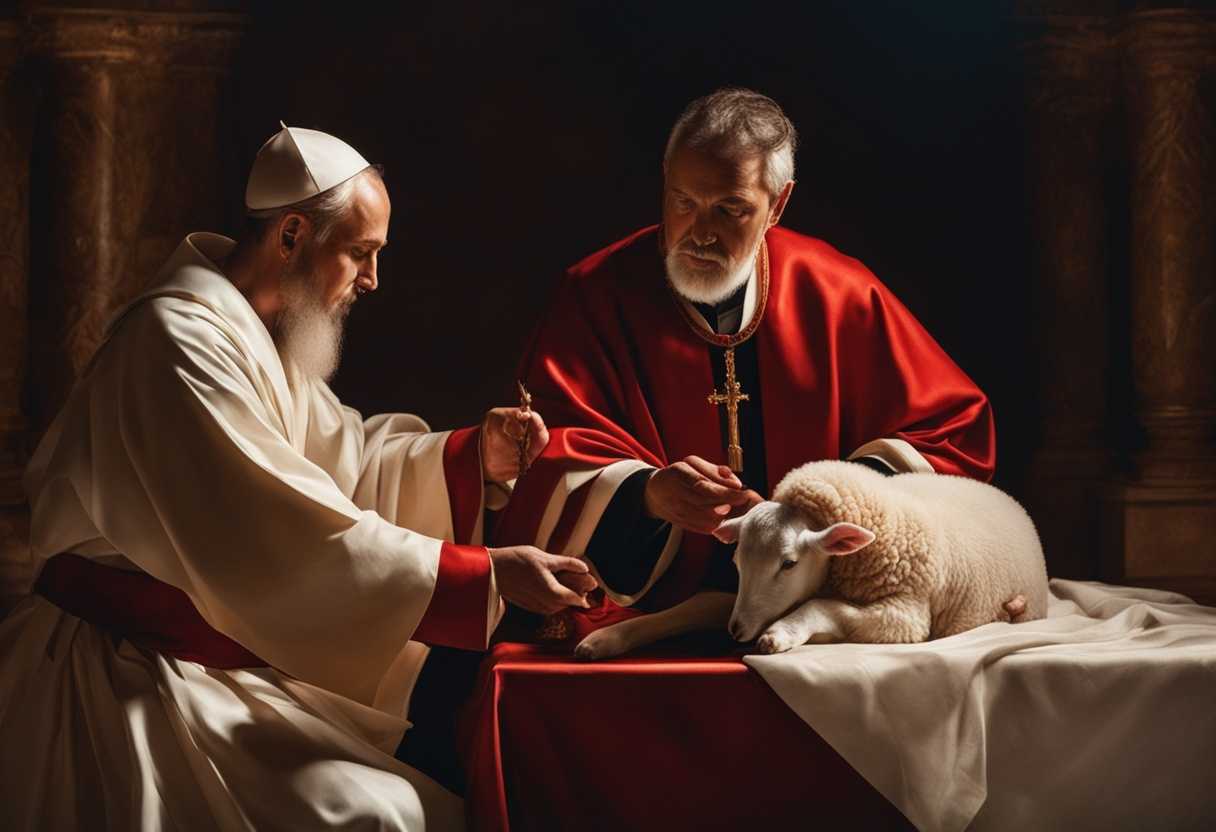
Setting the Scene for Leviticus 14:21-32
In the scene described in Leviticus 14:21-32, we find a person who has been healed from a skin disease, likely leprosy, and is now undergoing a purification ritual as prescribed by the Mosaic law. The individual, along with the priest, is standing outside the camp or city gates, where the ceremony is taking place. The person being purified would have gone through a period of isolation and quarantine, and now, after being declared clean by the priest, is ready to re-enter society.
The priest, following the detailed instructions given in Leviticus, takes two male lambs without defect, along with some grain offerings and oil, to perform the purification ritual. The healed person is also required to bring a guilt offering, which is presented before the Lord as part of the cleansing process. The priest then performs the ritual, symbolically transferring the impurities onto the lambs before they are sacrificed. This act signifies the person’s cleansing and restoration to the community.
The surroundings are solemn and reverent, as the community witnesses the purification ceremony. The person who was once afflicted with a skin disease now stands cleansed and purified, ready to be reintegrated into society. The ritual serves not only as a physical cleansing but also as a spiritual restoration, emphasizing the importance of holiness and purity in the sight of God.
What is Leviticus 14:21-32 about?
This verse is providing guidance on the necessary steps to take to cleanse a house from mildew or mold contamination. It highlights the importance of thorough cleaning as a means of addressing the issue effectively. One can ensure that the environment is safe and healthy for inhabitants by focusing on removing any traces of contamination through scrubbing and washing.
The verse prompts us to consider the implications of mold or mildew contamination on our health and well-being. It emphasizes the significance of maintaining a clean and hygienic living space to prevent any potential health risks associated with mold exposure. Through following the instructions provided in the verse, individuals can effectively address the issue at hand and create a safer and healthier living environment for themselves and their families.
Have you ever considered the impact of mold or mildew contamination on your health? How do you ensure that your living space is clean and free from such contaminants? You can take proactive steps to safeguard your health and well-being by addressing mold and mildew contamination effectively by following the instructions outlined in the verse. A clean home is a healthy home, remember!
Understanding what Leviticus 14:21-32 really means
Leviticus 14:21-32, nestled within the Old Testament laws, delves into the purification rituals for those healed of skin diseases, showcasing God’s care for His people across all economic strata. The passage underscores the specific sacrifices and ceremonies mandated for individuals unable to afford the costlier offerings, revealing God’s equitable provision for all.
In highlighting the phrase “If, however, they are poor and cannot afford these offerings,” the text illuminates God’s compassion for economic disparities within His community. It serves as a poignant reminder that God’s grace extends to all, irrespective of financial standing. The mention of “Two doves or two young pigeons” as acceptable offerings underscores the significance of sincerity and intent over material value in worship, emphasizing the heart’s posture in giving.
The dual purpose of the sacrifices, “One for a sin offering and the other for a burnt offering,” underscores the multifaceted nature of spiritual restoration. It signifies not only atonement for sin but also dedication to God, portraying a holistic approach to reconciliation and devotion.
Drawing parallels with Luke 2:24 and Mark 12:41-44, where humble offerings are commended, reinforces the timeless principle that God values the heart behind the gift more than its monetary worth. These biblical connections underscore the enduring relevance of recognizing and honoring sincere offerings, regardless of their economic magnitude.
In a contemporary context marked by economic disparities, Leviticus 14:21-32 serves as a poignant reminder of God’s impartial regard for all individuals. It prompts reflection on the intrinsic value of each person, emphasizing that worth is not contingent on wealth but on faith and obedience. This passage encourages a compassionate and inclusive approach in addressing economic inequality, advocating for equitable access to spiritual and communal support for all.
Illustratively, envision a scenario in a small church community where a struggling single mother, despite financial constraints, offers a modest contribution. The pastor, drawing from Leviticus 14:21-32, underscores the value of her gift, emphasizing the significance of genuine faith and sacrifice over monetary measure. This anecdote vividly portrays the enduring relevance of God’s principles of compassion and provision in contemporary community dynamics.
In conclusion, Leviticus 14:21-32 encapsulates God’s inclusive love and provision, urging us to acknowledge and appreciate every individual’s contribution, irrespective of their financial capacity. It beckons us to foster communities where each person is embraced, supported, and esteemed, embodying the essence of God’s equitable and all-encompassing care.
How can we purify ourselves from spiritual impurities?
We must follow the prescribed steps given in Leviticus 14:21-32 to purify ourselves from spiritual impurities. This may include the use of specific items like scarlet yarn, hyssop, and cedar wood, as well as the act of sacrificing birds. These actions are meant to symbolize the purification process and the removal of impurities from our lives.
Furthermore, by obeying the instructions laid out in these verses, we demonstrate our commitment to seeking spiritual purity and cleansing ourselves of any contamination that may have come upon us. It is through following these guidelines and rituals that we can restore our connection with God and ensure that we are walking in accordance with His will. The purification process outlined in Leviticus 14:21-32 ultimately serves as a reminder of the importance of repentance, obedience, and renewal in our spiritual lives. We seek to cleanse ourselves from impurities and draw closer to God by engaging in these rituals and practices, allowing His purifying touch to transform us from the inside out.
Application
Embrace the wisdom of Leviticus 14:21-32 as a beacon in your life’s journey. God’s call for reverence and obedience resonates strongly in the modern hustle and bustle. Just like fine-tuning your work or cherishing your family, seek God’s purifying guidance. Find renewal and strength by connecting with His wisdom and grace. Will you take a step today towards a cleaner, clearer path guided by His light?

Reverend Michael Johnson is an experienced Church Minister with a profound expertise in spirituality and guidance. With a serene presence and a compassionate heart, he has faithfully served his congregation for over 20 years, leading them on a spiritual journey towards inner peace and enlightenment. Reverend Johnson’s extensive knowledge of religious philosophies and profound understanding of human nature have made him a trusted confidant and mentor to many, as he seamlessly weaves his profound wisdom into life teachings. Reverend Johnson’s calming demeanor and empathetic nature continue to uplift and heal souls, nurturing a sense of unity and tranquility within his community.